Analysis and report by Ross Harvison and Murali Rajagopalachari (ISM-Houston Business Survey Committee)
Houston SCMI at 53.5 (down 0.1 points)
Sales/New Orders Expanding
Production Expanding
Employment Expanding
Prices Paid Expanding
Lead Times Expanding
Finished Goods Inventories Expanding
(Houston, Texas) – According to Houston area supply chain executives, the Houston economy expanded again in August. The manufacturing sector moved to expansion after two months showing contraction, and non-manufacturing activities expanded for the seventh month. The overall Houston economy expanded for the 75th month in a row.
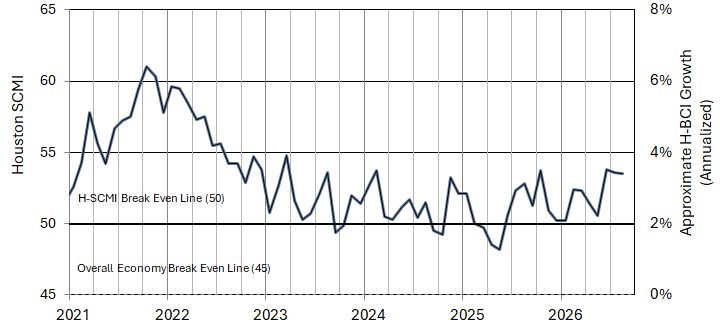
The Houston Supply Chain Managers Index fell 0.1 points to 53.5, indicating continued strong growth in the overall economy. All three of the underlying indicators that have a strong direct correlation with economic activity (sales/new orders, employment, and lead times) are continuing to point to modest to strong growth. The sales/new orders index fell 4.3 points to 52.2 points, the employment index rose 1.2 points to 53.4, and the lead times index rose 3.8 points to 57.1 points. The finished goods inventory index, the underlying indicator that has the strongest inverse correlation with economic activity, rose 1.3 points to 50.0 points.
The Houston Manufacturing SCMI rose 5.1 points to 51.7 points. Durable goods manufacturing recovered significantly but is still pointing to contraction. Non-durable goods improved somewhat to show greater strength than last month. The non-manufacturing SCMI fell 1.2 points to 53.8, indicating minimal weakening from last month.
On an industry specific basis construction, professional services, health care, non-durable goods manufacturing, trade/transportation/warehousing, and oil and gas extraction all reported strong expansion. Durable goods manufacturing continues to report significant weakness.
Note that beginning last month the Houston Affiliate of the Institute for Supply Management has changed the name of the index produced as part of this report to the Houston Supply Chain Managers Index (HSCMI) to recognize the input of a broad group of Supply Chain Leaders in the business survey that is used to develop the report. The analytical methods used to calculate all indices are unchanged.
Click here for the hard copy version of this report.
Houston SCMI Trend
Indices at a Glance
Houston SCMI readings over fifty indicate that respondents see their activities as expanding. An H-SCMI above 45 normally correlates with expansion of the Houston-The Woodlands-Sugar Land Business Cycle Index.
| Index | Aug | Jul | Change | Track | Rate | Trend* |
| Houston Overall PMI | 53.5 | 53.6 | -0.1 | Expanding | Slower | 15 |
| Houston Manufacturing PMI | 51.7 | 46.6 | 5.1 | Expanding | Fr. Cont. | 1 |
| Houston Non-Manufacturing PMI | 53.8 | 55.0 | -1.2 | Expanding | Slower | 7 |
| Sales/New Orders | 52.2 | 56.5 | -4.3 | Expanding | Slower | 8 |
| Production | 51.9 | 52.2 | -0.3 | Expanding | Slower | 3 |
| Employment | 53.4 | 52.2 | 1.2 | Expanding | Faster | 7 |
| Purchases | 51.0 | 58.9 | -7.9 | Expanding | Slower | 32 |
| Prices Paid | 57.0 | 62.3 | -5.3 | Expanding | Slower | 11 |
| Lead Times | 57.1 | 53.3 | 3.8 | Expanding | Faster | 9 |
| Purchased Inventory | 45.8 | 51.6 | -5.8 | Contracting | Fr. Exp. | 1 |
| Finished Goods Inventory | 50.0 | 48.7 | 1.3 | Expanding | Fr. Cont. | 1 |
| Overall Houston Economy | Expanding | Slower | 75 | |||
| * Number of months on current track | ||||||
Commodities Reported to be Up/Down in Price or in Short Supply
Up in Price: Travel services; crude oil, diesel, jet fuel; normal butane, isobutane, natural gasoline, naphtha; methanol, potassium hydroxide briquettes, films, polyethylene, polypropylene, imported goods; precious metals for catalysts (gold, silver, platinum, palladium, rhodium), industrial metals (copper, nickel, zinc), carbon and alloy steel products, pipe; compressors, motors, electrical equipment, electronics; bulk and dry trucking, dry bulk ocean freight, ocean container freight.
Down in Price: Tape, lumber, aluminum, some US manufactured products.
In Short Supply: Craft labor; petrochemical feedstocks, nitric acid, resins, yttrium and other rare earth minerals; gas turbine engines; electronics, transformers; steel, tungsten, inconel, steel forgings of all grades, modular steel frame buildings; bulk trucking, iso containers.
‡ Noted as being up or down by different respondents.
What Our Respondents Are Saying:
Oil and Gas Exploration, and Key Support Services:
- Tariffs, rare earth restrictions, power generation demand surge and capacity constraints are all of concern.
- Crude and motor fuel prices rose in August and have not moderated to the lower prices seen in the early summer.
- Texas rig counts continue to rise at a modest pace.
- This sector reported expansion for the second month. The sales/new orders, employment, prices paid, and lead time indices all showed moderate strength.
Construction:
- The uncertainty in the Middle East continues to present upside price risks.
- This sector continues to experience strong expansion. The sales/new orders, employment, prices paid, and lead times indices showed strength.
Durable Goods Manufacturing:
- Demand for our goods within the aerospace industry has improved our year-over-year sales.
- This sector reported significantly less weakness this month. The sales/new orders, production, and employment indices contracted at a much slower pace.
Non-durable Goods Manufacturing:
- Producers are very tight on feedstocks for chemicals. There have been some reformulations, but inventory is nonexistent. Third party sales from producers are on steep allocation for internal use and specific contractual volume.
- Diesel pricing is driving trucking cost, and carriers are asking for increases. Driver availability is also low.
- Petrochemical feedstock prices were mixed with light materials (ethane and propane) remaining flat and heavier materials (C4s and above) rising 5-10%.
- Polyolefin pricing continues to rise while olefin prices have remained relatively stable.
- Precious metal prices continue to run at high levels.
- This sector strengthened further this month again. The sales/new orders, production, purchases, prices paid, and lead times indices all showed strength. The employment index continues to point to considerable weakness.
Trade, Transportation, and Warehousing:
- Seeing some price softening in the marketplace countered by fuel prices increases hitting certain commodities.
- Container freight rates from Asia continue to rise.
- Houston air passenger traffic fell in August consistent with normal seasonal trends.
- This sector, while continuing to indicate positive results, reported considerably less strength. The sales/new orders, purchases, and prices paid indices moderated to near neutral.
Real Estate:
- Houston office real estate vacancies remain high.
- Industrial real estate vacancies remain low.
- This sector reported near neutral this month with all indices reporting near this level.
Professional and Business Services:
- We experienced an uptick in the number of companies either hiring direct or contract labor. However, there is no shortage of available candidates for normal non-specific technical expertise. Prices paid are staying very flat and downward pricing movements are not in our forecast.
- In the Energy sector there is some movement in adding staff. But this is being accomplished by independents and not the majors. The majors are still looking at ways to improve efficiency, and having leaner staff levels is one of those ways.
- This sector reported strong expansion with the sales/new orders and employment indices continuing to be reported as expanding.
Health Care:
- We continue to feel the impact of tariffs.
- We are beginning to experience fuel charges being added to our invoices resulting in a higher price being paid. We can’t afford to simply pass that increase cost to patients. These costs will primarily impact our margins
- This sector reported strong expansion with the sales/new orders, purchases, prices paid and lead times indices showing strength. All other indices reported near neutral.
Trend of Underlying Indicators
Sales/New Order Index
The sales/new orders index fell 4.3 points to 52.2 points during the month. Both non-manufacturing and manufacturing reported expansion in this index.
| Sales/New Orders | Higher | Same | Lower | Net | Index |
| Mar 2026 | 19% | 74% | 7% | 12% | 54.0 |
| Apr 2026 | 17% | 78% | 5% | 12% | 53.5 |
| May 2026 | 11% | 84% | 5% | 6% | 50.3 |
| Jun 2026 | 23% | 72% | 5% | 18% | 59.4 |
| Jul 2026 | 16% | 79% | 5% | 11% | 56.5 |
| Aug 2026 | 10% | 83% | 7% | 3% | 52.2 |
Production Index
The production index was relatively unchanged this month, falling 0.3 points to 51.9. Both non-manufacturing and manufacturing reported just above neutral again this month.
| Production | Higher | Same | Lower | Net | Index |
| Mar 2026 | 4% | 89% | 7% | -3% | 47.4 |
| Apr 2026 | 5% | 93% | 2% | 3% | 50.4 |
| May 2026 | 5% | 90% | 5% | 0% | 48.9 |
| Jun 2026 | 8% | 87% | 5% | 3% | 52.2 |
| Jul 2026 | 9% | 87% | 4% | 5% | 52.2 |
| Aug 2026 | 8% | 89% | 3% | 5% | 51.9 |
Employment Index
The employment index rose 1.2 points to 53.4, indicating continued minimal expansion. Non-manufacturing came in above neutral and manufacturing continued to report well below this level.
| Employment | Higher | Same | Lower | Net | Index |
| Mar 2026 | 6% | 90% | 4% | 2% | 51.0 |
| Apr 2026 | 8% | 88% | 4% | 4% | 50.7 |
| May 2026 | 8% | 86% | 6% | 2% | 50.5 |
| Jun 2026 | 13% | 79% | 8% | 5% | 51.4 |
| Jul 2026 | 12% | 80% | 8% | 4% | 52.2 |
| Aug 2026 | 11% | 82% | 7% | 4% | 53.4 |
Purchases Index
The purchases index fell 7.9 points to 51.0 points. Non-manufacturing fell to near neutral and manufacturing fell to well below this level.
| Purchases | Higher | Same | Lower | Net | Index |
| Mar 2026 | 17% | 77% | 6% | 11% | 54.1 |
| Apr 2026 | 19% | 75% | 6% | 13% | 53.8 |
| May 2026 | 20% | 74% | 6% | 14% | 55.1 |
| Jun 2026 | 18% | 75% | 7% | 11% | 55.5 |
| Jul 2026 | 20% | 78% | 2% | 18% | 58.9 |
| Aug 2026 | 10% | 81% | 9% | 1% | 51.0 |
Prices Paid Index
The purchases index fell 5.3 points to 57.0 with non-manufacturing relatively unchanged and manufacturing reporting continued strength, but at a lower level than last month.
| Prices Paid | Higher | Same | Lower | Net | Index |
| Mar 2026 | 25% | 73% | 2% | 23% | 59.5 |
| Apr 2026 | 34% | 64% | 2% | 32% | 64.3 |
| May 2026 | 35% | 63% | 2% | 33% | 65.1 |
| Jun 2026 | 23% | 74% | 3% | 20% | 61.4 |
| Jul 2026 | 24% | 74% | 2% | 22% | 62.3 |
| Aug 2026 | 17% | 81% | 2% | 15% | 57.0 |
Lead Times Index
The purchases index rose 3.8 points to 57.1 points with manufacturing reporting continued strong expansion in this index and non-manufacturing reporting just above neutral.
| Lead Times | Higher | Same | Lower | Net | Index |
| Mar 2026 | 17% | 79% | 4% | 13% | 54.0 |
| Apr 2026 | 7% | 91% | 2% | 5% | 51.0 |
| May 2026 | 9% | 86% | 5% | 4% | 51.3 |
| Jun 2026 | 8% | 89% | 3% | 5% | 52.7 |
| Jul 2026 | 14% | 80% | 6% | 8% | 53.3 |
| Aug 2026 | 15% | 83% | 2% | 13% | 57.1 |
Purchased Inventory Index
The purchased inventory index fell 5.8 points to 45.8 with non-manufacturing reporting just above neutral and manufacturing reporting significant contraction in this index.
| Purchased Inventory | Higher | Same | Lower | Net | Index |
| Mar 2026 | 5% | 90% | 5% | 0% | 48.3 |
| Apr 2026 | 4% | 90% | 6% | -2% | 49.2 |
| May 2026 | 3% | 93% | 4% | -1% | 48.1 |
| Jun 2026 | 3% | 92% | 5% | -2% | 48.7 |
| Jul 2026 | 5% | 92% | 3% | 2% | 51.6 |
| Aug 2026 | 2% | 89% | 9% | -7% | 45.8 |
Finished Goods Inventory Index
The finished goods inventory index rose to neutral, gaining 1.3 points to 50.0 points with both manufacturing and non-manufacturing reporting near this level.
| Finished Goods Inventories | Higher | Same | Lower | Net | Index |
| Mar 2026 | 6% | 89% | 5% | 1% | 50.7 |
| Apr 2026 | 8% | 86% | 6% | 2% | 51.3 |
| May 2026 | 5% | 90% | 5% | 0% | 49.7 |
| Jun 2026 | 7% | 88% | 5% | 2% | 50.8 |
| Jul 2026 | 4% | 89% | 7% | -3% | 48.7 |
| Aug 2026 | 4% | 92% | 4% | 0% | 50.0 |
Houston SCMI Calculation Methods
The Houston Supply Chain Managers Index has been included as an integral part of the ISM-Houston Business Report since the Houston affiliate of the Institute for Supply Management started publishing this document in January 1995. The report and index are issued monthly as the primary deliverables from a survey of Houston area Supply Chain leaders regarding the status of key activities that provide insight into the strength of the economy. The respondents come from diverse organizations including construction, energy, engineering, health care, durable and non-durable goods manufacturing, financial and business services, wholesale and retail trade, and utilities related companies.
The Houston Supply Chain Managers Index is determined from diffusion indices of the eight indicators of economic activity covered by the ISM-Houston Business Survey and Report. These underlying indicators are sales or new orders, production, employment, purchases, prices paid for major purchases, lead times from sellers, purchased materials inventory (raw materials and supplies), and finished goods inventories. The respondents to the survey report the direction of each of these activities as either up, the same, or down in comparison to the previous month. An index for each of these areas is then calculated by subtracting the percentage of respondents that sight a negative shift from the percentage that sight a positive shift. For indicators that are positively correlated with economic growth, this results in an underlying index that points to expansion when it is above zero. Indicators that are negatively correlated with growth point to expansion when they are below zero.
The final Houston SCMI is calculated by applying optimal regression factors to each of the eight underlying indicators noted above. These regression factors are determined using standard regression techniques comparing these underlying indicators to the Houston-The Woodlands-Sugar Land Business Cycle Index (Houston BCI), which is reported monthly by the Federal Reserve Bank of Dallas. This top-level index is converted to a 0 to 100 scale to match that of the national Purchasing Managers Index® (PMI®) which is published monthly by the Institute for Supply Management® (ISM®). Readings over 50 for the HSCMI generally indicate manufacturing expansion in Houston in the near term and readings below 50 show coming manufacturing contraction.
It is important to note that the manufacturing breakeven HSCMI does not equate to the breakeven point for the overall Houston economy. ISM-Houston periodically reviews the capability of its correlations and adjusts the regression factors when appropriate. The most recent revision occurred in 2018 after it was determined that changes in the Houston economy over the previous decade had shifted the intercept of the correlation, causing a neutral Houston SCMI to no longer align with a neutral Houston BCI. A Houston SCMI of 45 points now equates to a neutral Houston economy as measured by the Houston BCI. A similar offset between the National SCMI and the National economy has existed for some time.
Use of ISM-Houston Business Report Content
All information included in this report is protected under copyright law, and ISM-Houston reserves all rights to this content. ISM-Houston grants a limited, revocable license for personal, non-commercial use, including access, printing, and display of content. Requests for permission to reproduce or redistribute the ISM-Houston Business Report content should be directed to the ISM-Houston Business Survey Committee at HSCMI@ism-houston.org.
ISM-Houston assumes no liability, obligation, or responsibility for the accuracy, completeness, or timeliness of the information contained herein. This includes any errors, omissions, or delays in providing the report. Furthermore, ISM-Houston shall not be liable for any damages, whether direct, incidental, consequential, or special, arising from the use or reliance on the information provided in this report.
ISM-Houston Business Report Background
The ISM-Houston Business Report has provided some of the best information regarding what is happening in the Greater Houston area economy for over 30 years. It delivers significant analytical data along with a summary of what Houston area Supply Chain Leaders are saying about the economy and is subscribed to by a wide range of global business leaders, economists, researchers, and reporters.
The report and index are published monthly as the primary deliverables from a survey of Houston area Supply Chain professionals. These highly engaged leaders provide information on key activities that are related to the strength of the economy. They come from diverse organizations including construction, energy, engineering, health care, durable and non-durable goods manufacturing, financial and business services, wholesale and retail trade, and utilities related companies.
We are always looking to improve our coverage of the industries that make up our economy. Please join us to help make our results even more representative of what’s happening in Houston by completing this signup form.