Houston PMI at 52.4 (up 2.2 points)
Sales/New Orders Expanding
Production Expanding
Employment Expanding
Prices Paid Expanding
Lead Times Expanding
Finished Goods Inventories Contracting
(Houston, Texas) – According to Houston area supply chain executives the Houston economy expanded again in February. The manufacturing sector expanded for the second month, and non-manufacturing returned to expansion. The overall Houston economy expanded for the 69th month in a row.
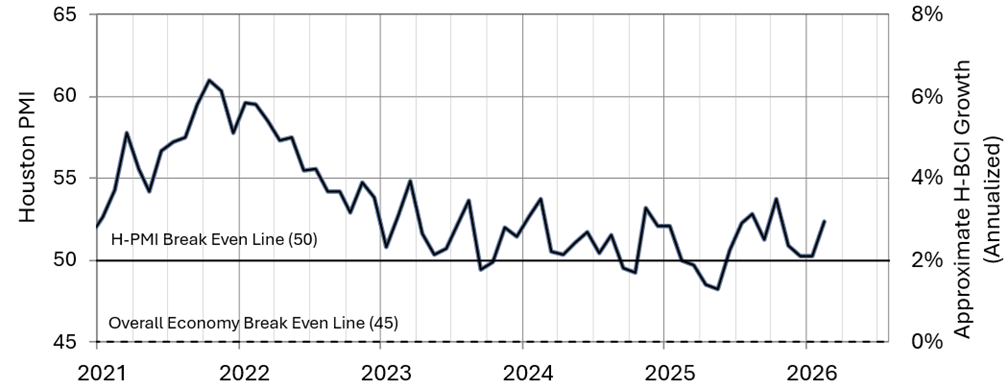
The Houston Purchasing Managers Index rose 2.2 points to 52.4 in February, indicating strengthening in the overall economy. All three of the underlying indicators that have a strong direct correlation with economic activity (sales/new orders, employment, and lead times) are now pointing to strength. The sales/new orders index rose 4.1 points to 56.6 points, the employment index rose 4.2 points to 50.9, and the lead times index fell 4.4 points to 50.1 points. The finished goods inventory index, the underlying indicator that has the strongest inverse correlation with economic activity, fell 1.5 points to 49.7, indicating expansion of this indicator for the eighth month in a row.
The Houston Manufacturing PMI rose a strong 6.1 points during the month to 53.0 points, indicating moderate to strong expansion in this sector for the first time in six months. The non-manufacturing PMI fell 1.1 points to 49.7, pointing to modest expansion after one month indication potential contraction.
On an industry specific basis oil and gas joined construction, professional services, and durable goods manufacturing reporting strong expansion. Trade, transportation, and warehousing joined non-durable goods manufacturing reporting modest expansion.
Please click here to go to the hardcopy version of the report.
Analysis and report by Ross Harvison (ISM-Houston Business Survey Committee Chair)
Houston PMI Trend
Indices at a Glance
Houston PMI readings over fifty indicate that respondents see their activities as expanding. An H-PMI above 45 normally correlates with expansion of the Houston-The Woodlands-Sugar Land Business Cycle Index.
| Index | Feb | Jan | Change | Track | Rate | Trend* |
| Houston Overall PMI | 52.4 | 50.2 | 2.2 | Expanding | Faster | 9 |
| Houston Manufacturing PMI | 51.6 | 53.0 | -1.4 | Expanding | Slower | 2 |
| Houston Non-Manufacturing PMI | 52.6 | 49.7 | 2.9 | Expanding | Fr. Cont. | 1 |
| Sales/New Orders | 56.6 | 52.5 | 4.1 | Rising | Faster | 2 |
| Production | 51.0 | 52.4 | -1.4 | Rising | Slower | 9 |
| Employment | 50.9 | 46.7 | 4.2 | Rising | Fr. Falling | 1 |
| Purchases | 57.9 | 53.3 | 4.6 | Rising | Faster | 26 |
| Prices Paid | 58.1 | 60.3 | -2.2 | Rising | Slower | 5 |
| Lead Times | 50.1 | 54.5 | -4.4 | Rising | Slower | 3 |
| Purchased Inventory | 53.6 | 48.9 | 4.7 | Rising | Fr. Falling | 1 |
| Finished Goods Inventory | 49.7 | 51.2 | -1.5 | Falling | Fr. Rising | 1 |
| Houston Economy | Expanding | Faster | 69 | |||
| * Number of months on current track | ||||||
Commodities Reported to be Up/Down in Price or in Short Supply
Up in Price: General labor, general services; crude oil, diesel, jet fuel; cracking feedstocks (natural gas liquids, propane, butanes); propylene; manufactured goods, stainless steel, carbon steel, structural steel, aluminum shapes, nickel, copper, aluminum; electrical equipment, gas turbine components, cement; container shipping.
Down in Price: Professional services; natural gas; breakbulk transportation; ocean container freight.
In Short Supply: Professional services, electrical services, skilled labor; tape; electrical equipment, electrical components, cabling, generators; tungsten.
‡ Reported as up or down in price by different respondents
What Our Respondents Are Saying:
Oil and Gas Exploration, and Key Support Services:
- Geopolitics issues continue to impact our supply chain logistics.
- This sector moved back to indicating expansion. The production and lead times indices joined the sales/new orders, purchases, and prices paid indices reporting a very strong tendency towards expansion. The employment index rose back to neutral.
Construction:
- Demand for data centers are driving market and work.
- Prices are elevated in the near term; however, weak market fundamentals and limited global demand are likely to exert downward pressure through 2026.
- This sector continues to experience strong expansion. The sales/new orders, employment, purchases, prices paid, and lead times are all pointing to significant strength.
Durable Goods Manufacturing:
- Steel and Aluminum commodities are up in price mostly due to tariffs.
- This sector continues to indicate moderate to strong expansion. The employment index joined sales/new orders, production, purchases, and prices paid indices showing strength. The lead times and inventory indices fell to near neutral.
Non-durable Goods Manufacturing:
- Cracker feedstock prices rose in late February and are rising further in early March.
- Refinery rates fell this month consistent with normal seasonal changes.
- Activities are stable with weak exports from US.
- Things remain flat for the time being.
- This sector fell back to neutral during the month with the sales, production, employment, purchases, and lead times indices all being reported near this level. The prices paid and finished goods inventory indices are pointing to economic expansion.
Trade, Transportation, and Warehousing:
- Global uncertainty remains a concern.
- Tariffs and Middle East geopolitical concerns have created uncertainty and have impacted pricing and demand.
- This sector returned to neutral during the month with sales/new orders, purchases, prices paid indices reported as expanding at a rapid pace. The employment index showed significant contraction again this month.
Professional and Business Services:
- We continue to see a very stagnant market; plenty of qualified people looking for jobs or who want to change jobs.
- We continue to be in an employer’s market.
- Companies are investing heavily in AI which is impacting all major support areas (construction, building, engineering, etc.). We don’t see any slowdown this year.
- Contractor wages and employee salaries remain very flat, even though more people are looking for jobs than there are jobs available.
- On the upper end of the scale (Director level or higher), compensation is not as lucrative today as compared to 4 years ago
- This sector continues to report expansion with the employment, purchases, and prices paid indices showing significant improvement. All other indices remain near neutral.
Trend of Underlying Indicators
Sales/New Order Index (Seasonally Adjusted)
The sales/new orders index improved significantly during the month, rising 4.1 points to 56.6 points. Non-manufacturing industries rose to well above this level during the month, manufacturing activities fell to near neutral.
| Sales/New Orders | Higher | Same | Lower | Net | Index |
| Sep 2025 | 11% | 86% | 3% | 8% | 55.6 |
| Oct 2025 | 16% | 79% | 5% | 11% | 60.8 |
| Nov 2025 | 11% | 83% | 6% | 5% | 54.4 |
| Dec 2025 | 11% | 74% | 15% | -4% | 49.9 |
| Jan 2026 | 18% | 72% | 10% | 8% | 52.5 |
| Feb 2026 | 22% | 75% | 3% | 19% | 56.6 |
Production Index (Seasonally Adjusted)
The production index fell a modest 1.4 points to 51.0. Non-manufacturing respondents reported just above neutral and manufacturing reported a significant improvement to indicate very strong expansion.
| Production | Higher | Same | Lower | Net | Index |
| Sep 2025 | 12% | 84% | 4% | 8% | 55.2 |
| Oct 2025 | 11% | 85% | 4% | 7% | 55.3 |
| Nov 2025 | 9% | 86% | 5% | 4% | 52.6 |
| Dec 2025 | 3% | 91% | 6% | -3% | 51.7 |
| Jan 2026 | 9% | 89% | 2% | 7% | 52.4 |
| Feb 2026 | 6% | 92% | 2% | 4% | 51.0 |
Employment Index (Seasonally Adjusted)
The employment index rose 4.2 points to 50.9 points returning to indicating expansion after two months showing contraction. Manufacturing returned to reporting this index as expanding after 21 months of contraction. Non-manufacturing also returned to reporting expansion after 2 months of contraction.
| Employment | Higher | Same | Lower | Net | Index |
| Sep 2025 | 11% | 72% | 17% | -6% | 48.5 |
| Oct 2025 | 8% | 83% | 9% | -1% | 50.3 |
| Nov 2025 | 9% | 83% | 8% | 1% | 51.2 |
| Dec 2025 | 2% | 91% | 7% | -5% | 49.3 |
| Jan 2026 | 6% | 84% | 10% | -4% | 46.7 |
| Feb 2026 | 10% | 84% | 6% | 4% | 50.9 |
Purchases Index (Seasonally Adjusted)
The purchases index rose 4.6 points to 57.9 points with both non-manufacturing and manufacturing reporting significant expansion.
| Purchases | Higher | Same | Lower | Net | Index |
| Sep 2025 | 16% | 76% | 8% | 8% | 55.5 |
| Oct 2025 | 15% | 78% | 7% | 8% | 55.8 |
| Nov 2025 | 14% | 71% | 15% | -1% | 51.5 |
| Dec 2025 | 7% | 81% | 12% | -5% | 50.7 |
| Jan 2026 | 19% | 73% | 8% | 11% | 53.3 |
| Feb 2026 | 21% | 77% | 2% | 19% | 57.9 |
Prices Paid Index (Seasonally Adjusted)
The prices paid index fell 2.2 points to 58.1 points, continuing to indicate strong expansion of this index. Both non-manufacturing and manufacturing reported this index near this level.
| Prices Paid | Higher | Same | Lower | Net | Index |
| Sep 2025 | 9% | 74% | 17% | -8% | 44.7 |
| Oct 2025 | 12% | 78% | 10% | 2% | 51.1 |
| Nov 2025 | 13% | 75% | 12% | 1% | 54.1 |
| Dec 2025 | 9% | 76% | 15% | -6% | 50.7 |
| Jan 2026 | 25% | 72% | 3% | 22% | 60.3 |
| Feb 2026 | 23% | 74% | 3% | 20% | 58.1 |
Lead Time Index (Seasonally Adjusted)
The lead times index moved to near neutral, falling 4.4 points to 50.1 with both manufacturing and non-manufacturing reporting near this level.
| Lead Times | Higher | Same | Lower | Net | Index |
| Sep 2025 | 7% | 90% | 3% | 4% | 51.3 |
| Oct 2025 | 8% | 87% | 5% | 3% | 52.6 |
| Nov 2025 | 2% | 89% | 9% | -7% | 47.8 |
| Dec 2025 | 4% | 94% | 2% | 2% | 53.2 |
| Jan 2026 | 8% | 88% | 4% | 4% | 54.5 |
| Feb 2026 | 7% | 89% | 4% | 3% | 50.1 |
Purchased Inventory Index (Seasonally Adjusted)
The purchased inventory index returned to reporting above neutral, rising 4.7 points to end at 53.6. The non-manufacturing purchased inventory index came in near neutral. Manufacturing reported purchased inventories as expanding at a significant rate for a second month.
| Purchased Inventory | Higher | Same | Lower | Net | Index |
| Sep 2025 | 6% | 85% | 9% | -3% | 48.3 |
| Oct 2025 | 6% | 87% | 7% | -1% | 50.6 |
| Nov 2025 | 8% | 89% | 3% | 5% | 52.5 |
| Dec 2025 | 5% | 89% | 6% | -1% | 52.9 |
| Jan 2026 | 5% | 91% | 4% | 1% | 48.9 |
| Feb 2026 | 6% | 91% | 3% | 3% | 53.6 |
Finished Goods Inventory Index (Seasonally Adjusted)
The finished goods inventory index moved to near neutral, falling 1.5 points to 49.7. Manufacturing joined non-manufacturing at this level.
| Finished Goods Inventories | Higher | Same | Lower | Net | Index |
| Sep 2025 | 8% | 85% | 7% | 1% | 50.3 |
| Oct 2025 | 10% | 84% | 6% | 4% | 51.9 |
| Nov 2025 | 13% | 84% | 3% | 10% | 54.5 |
| Dec 2025 | 7% | 89% | 4% | 3% | 51.2 |
| Jan 2026 | 6% | 91% | 3% | 3% | 51.2 |
| Feb 2026 | 4% | 91% | 5% | -1% | 49.7 |
Houston PMI Calculation Methods
The Houston Purchasing Managers Index has been included as an integral part of the ISM-Houston Business Report since the Houston affiliate of the Institute for Supply Management started publishing this document in January 1995. The report and index are issued monthly as the primary deliverables from a survey of Houston area Supply Chain leaders regarding the status of key activities that provide insight into the strength of the economy. The respondents come from diverse organizations including construction, energy, engineering, health care, durable and non-durable goods manufacturing, financial and business services, wholesale and retail trade, and utilities related companies.
The Houston Purchasing Managers Index is determined from diffusion indices of the eight indicators of economic activity covered by the ISM-Houston Business Survey and Report. These underlying indicators are sales or new orders, production, employment, purchases, prices paid for major purchases, lead times from sellers, purchased materials inventory (raw materials and supplies), and finished goods inventories. The respondents to the survey report the direction of each of these activities as either up, the same, or down in comparison to the previous month. An index for each of these areas is then calculated by subtracting the percentage of respondents that sight a negative shift from the percentage that sight a positive shift. For indicators that are positively correlated with economic growth, this results in an underlying index that points to expansion when it is above zero. Indicators that are negatively correlated with growth point to expansion when they are below zero.
The final Houston PMI is calculated by applying optimal regression factors to each of the eight underlying indicators noted above. These regression factors are determined using standard regression techniques comparing these underlying indicators to the Houston-The Woodlands-Sugar Land Business Cycle Index (Houston BCI), which is reported monthly by the Federal Reserve Bank of Dallas. This top-level index is converted to a 0 to 100 scale to match that of the national Purchasing Managers Index® (PMI®) which is published monthly by the Institute for Supply Management® (ISM®). Readings over 50 for the HPMI generally indicate manufacturing expansion in Houston in the near term and readings below 50 show coming manufacturing contraction.
It is important to note that the manufacturing breakeven HPMI does not equate to the breakeven point for the overall Houston economy. ISM-Houston periodically reviews the capability of its correlations and adjusts the regression factors when appropriate. The most recent revision occurred in 2018 after it was determined that changes in the Houston economy over the previous decade had shifted the intercept of the correlation, causing a neutral Houston PMI to no longer align with a neutral Houston BCI. A Houston PMI of 45 points now equates to a neutral Houston economy as measured by the Houston BCI. A similar offset between the National PMI and the National economy has existed for some time.
Use of ISM-Houston Business Report Content
All information included in this report is protected under copyright law, and ISM-Houston reserves all rights to this content. ISM-Houston grants a limited, revocable license for personal, non-commercial use, including access, printing, and display of content. Requests for permission to reproduce or redistribute the ISM-Houston Business Report content should be directed to the ISM-Houston Business Survey Committee at hpmi@ism-houston.org.
ISM-Houston assumes no liability, obligation, or responsibility for the accuracy, completeness, or timeliness of the information contained herein. This includes any errors, omissions, or delays in providing the report. Furthermore, ISM-Houston shall not be liable for any damages, whether direct, incidental, consequential, or special, arising from the use or reliance on the information provided in this report.
ISM-Houston Business Report Background
The ISM-Houston Purchasing Manager Report has provided some of the best information regarding what is happening in the Greater Houston area economy for over 25 years. It delivers significant analytical data along with a summary of what Houston area Supply Chain Leaders are saying about the economy and is subscribed to by a wide range of global business leaders, economists, researchers, and reporters.
The report and index are published monthly as the primary deliverables from a survey of Houston area Supply Chain professionals. These highly engaged leaders provide information on key activities that are related to the strength of the economy. They come from diverse organizations including construction, energy, engineering, health care, durable and non-durable goods manufacturing, financial and business services, wholesale and retail trade, and utilities related companies.
We are always looking to improve our coverage of the industries that make up our economy. Please join us to help make our results even more representative of what’s happening in Houston by completing this signup form.